 Bradley Valentin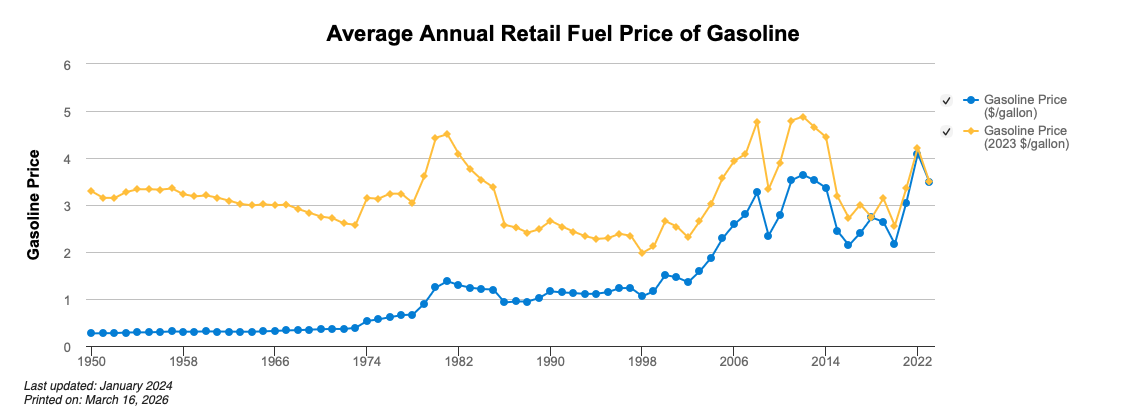
Gas prices have been jumping at an alarming rate over the last few weeks. The United States’ conflict in Iran is a major component to be evaluated here, but we will also evaluate the long-term impact on prices. Oil and gas are very inelastic, meaning that your demand for gas does not depend on the price, however, prices can see major swings due to major factors on supply and world events.
Gas Prices – A Timeline
Gas prices are extremely volatile and have a major impact on our monthly reporting of inflation in the United States. Some months, consumers may see prices around $2.75/gallon, while the next month they may see prices over $3.50. Regardless of the price, people still need their gas to get to and from work, and there is little anyone can do about it, at least on the consumer level.
The last five years of gas and oil prices have seen significant volatility, with low prices in 2025 and record highs in 2022. However, in the United States, we can trace our gasoline prices back several generations, and when you actually see the results, you might be surprised. Let’s go back about 75 years and examine the major fluctuations in prices over the last several decades.
Source: U.S. Department of Energy
Over the 75 years, we’ve seen a 1,277% increase in gas prices (as of March 16, 2026). In 1950, the average consumer paid around $0.27/gallon of gas, and today, the U.S. average is around $3.71/gallon. This seems extreme, however, when you look at overall inflation, the prices are not as extreme as you might think.
In the above chart, you can see the actual gasoline price in blue, and the gasoline price in 2023 prices. So, how much is $0.27 in 2026 money? The answer is about $3.75… (Based on the U.S. Bureau of Labor Statistics CPI Inflation Calculator).
Gas prices saw a huge bump in the late 1970s-early 1980s. In the 70s, we saw a major world event that saw gas prices skyrocket to about $1.50/gallon (around $7.20 in 2026). The cause of the crisis? The Iranian Revolution. Yes, 50 years ago, Iran was in the middle of the world’s crisis with energy prices. Because of issues with oil reserves, and inflation in the United States, the Federal Reserve was concerned about interest rates. Laurel Graefe of federalreservehistory.org wrote this:
Through early 1978, the Federal Reserve had maintained a highly accommodative stance of monetary policy, hoping to combat rising unemployment. Ultimately, though, the policies showed little success in stifling the deterioration in the unemployment rate and likely fostered an environment that allowed the rising energy prices to be transmitted into more general inflation. Consumer inflation, which had already begun to accelerate in the United States, continued to rise—from below 5 percent in early 1976 to nearly 7 percent by March 1979. By that time, unease among members of the Federal Open Market Committee (FOMC) that inflation could continue to rise was growing. Records from the meeting of the FOMC on February 28, 1978, indicate that “considerable concern was expressed that the rate of inflation might accelerate significantly as the year progressed [and could] pose difficult questions concerning the appropriate role of monetary policy.” Nevertheless, the committee voted unanimously to keep the policy rate unchanged.
Prices dropped again in the mid-80’s, but would continue to slowly rise with inflation. The next major increases we would see in gas prices would be in the 2000s. Because of major demand increases from the world’s economy, as well as major increases in demand from China. The world was growing, and it seemed that prices would forever go up.
2021 and 2022 saw particularly expensive gas prices, brought on by economic policy and a major crisis in Europe. The highest recorded average price in the United States was in June of 2022, at $5.02/gallon. Some consumers in places like California were paying prices of nearly $7/gallon.
Prices started to drop in 2024, and strong economic policy and oil production in 2025 brought gas prices down to as low as $2.81/gallon in $2.81. For reference, that is around $0.20 in 1950.
Gas Prices Today and The Iran Crisis
Once again, Iran is at the center of our current oil/gas crisis. Operation Epic Fury started on February 28, 2026, and since that date, the U.S. consumer has seen a hit at the pumps.
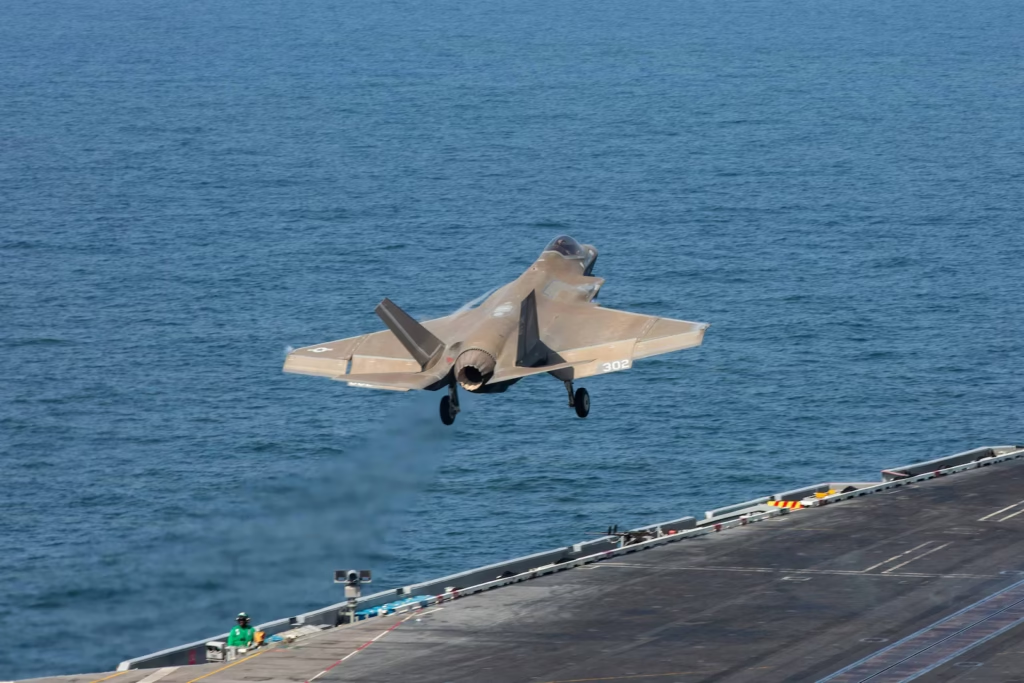
While just a few months ago, gas prices were below $2/gallon for millions of Americans, many are paying over $4/gallon. While that price is still relatively low compared to the Iranian Crisis of 1979 (after inflation), these prices are still impacting Americans and their budgets.
President Donald Trump has stated with confidence that many countries are on their way to help the U.S. to keep the Hormuz Strait open. The Hormuz Strait sees about 20% of global oil trade, and while there is still 80% of the oil in the world easily accessible, this is a major impact on gas/oil prices, especially in the West. Much of the oil that goes through the Straight already goes to the East to countries like China, India, Japan, and Korea, which means the West, and countries like the United States, rely on other oil production.
The Long-Term Impact
Considering inflation, and the historical prices of gasoline, today, prices may seem high, but they still sit about average. Americans may still see major increases in prices over the next few weeks, but once the conflict in Iran is resolved, they will likely see prices drop down to closer to $3/gallon. Unfortauntely, we do not know how long that will take, as we’ve heard that the conflict could be over quickly, but there’s no guarantees.
In the meantime, it’s important to budget for higher gas prices. Gas is simply a must for almost all Americans. So budget accordingly. If you are living on a tight budget each week/month, then make sure that you adjust your additional spending. You may have to cut down on entertainment expenses in the meantime. If you need help with a budget, check out our starter budget here.
About the Author
